Last time out was my seven starter points for strategic thinking and today I’m going to talk through the nine (and a half) step strategic process I’ve been following in my new role.
Step 1 – Know yourself
Sounds obvious, right? But this is where you’ve got to start. This isn’t about just knowing ‘I’m Sam and I’m an [fill in the blank]’. Knowing yourself is fundamental stuff – WHY do you do what you’re setting out to do with this strategy. Not just the stuff at the end of it (like selling stuff, engaging people, turning a profit) but what’s a the core. You might like to go back to the starter points to determine what you’re about.
When you know what you stand for, you’ll be able to determine your vision and mission. Vision and mission differ – to have both, I think, is relatively important. Your vision is virtually unobtainable – it’s the utopia you are striving for. Your mission is focused on the length of the strategy (i.e. what do you see will happen in 3-5 years from now?).
Your vision and mission will lead to loads of questions about ‘how will we know’? This is also where you need to establish some goals and targets.
Express goals in the present and use exciting, compelling terminology to instil a unity of purpose. Goals (or aims or outcomes depending on what you want to call them) are the things that have changed at the end of the strategy period – ‘to sell more of X than anyone else’; ‘to communicate in an effective and personal way’; etc. It’s worth establishing three sets of goals – goals for your customers; goals for your stakeholders; goals for yourself. The goals for your customers should express why your customers will choose you over others. Your goals for your stakeholders will delight them and show that you are successful in meeting your strategy. Your goals for yourself are about excelling in everything you do so that you can maintain and grow your advantage.
Targets sit under your goals. They measure how you know if you’ve met the goal or not. If the goal is about market share then the targets say what % market share you want in each year.
Work on around 3 goals for customers, 3 for stakeholders and 3+ for yourself. For each goal, establish 3 or so targets.
Now you know what you’re about.
Step 2 –Know the market
Who the frig wants to get stuff from you? And if they do? Who are they?
Knowing the market is about the analysis bits – SWOTs and PESTs and research. I am sometimes a little dubious about over market-researching. One of my favourite [perhaps imagined] quotes is Henry Ford saying
if I asked my customers what they wanted, they would have said a faster horse…
Anyway, it is worth segmenting or grouping your customers at this point based on data or trends that you know.
Step 3 – Know the bad guys
I find the concept of having ‘bad guys’ really useful for strategy. They can galvanise support around your proposed ideas because you want to be better/more creative/more inspiring than them. Apple did this really successfully with the 1984 Mac/IBM advert.
You just watch it and think ‘yeah, screw you, IBM’…great!
To help you determine the enemy, you can use SWOT again of course, but more simply you can list your competitors, list what they do and then think about what your competitive advantage is over them. If you can’t think of any, maybe you can copy elements of what they do…and then do them better!
Step 4 – Pick your audience
OK – primary analysis done. Now on to secondary analysis.
Picking your audience is about revisiting the work you’ve done so far and thinking about your customer segments and groups and starting to prioritise them. Which groups are most attractive to what you’re trying to achieve (look back at your vision, mission, goals and targets).
I think this stage is crucial – because so many people daren’t choose. They want to be all things to all people and you know what? You can’t. The successful businesses know their preferred audience and work to that. And that’s fine.
Step 4 and a half – Customer Value Proposition
Using what you know, you should now look at the following matrix to work out your Customer Value Proposition – matching an offer to each segment.
Up the side, put your priority of audience; along the bottom think about strength of your propositions (what you’ve got to offer).
This is the best thing I’ve learnt in the last couple of weeks…
Then go through – starting at the top and think about what you’ve got to offer each segment and plot how attratcive it is to them. If, for example, your top priority segment is young, trendy, smartphone types and you produce a hard copy book – it’s not going to be attractive. But if you’ve got an e-book version, that is a more attractive offer….plot it on the right. Go on.
You’ll end up with a nice splodgy chart of mess. Then you can overlay the grid below to see what you should be doing…
- If it’s your top priority segment and you’ve got something great for them – go for it!
- If it’s your top priority segment and it’s ok – aim to be the best at it
- If you’ve got a great offer for your middle priority segment – invest in it and get them in
You can see the rest of the principle…
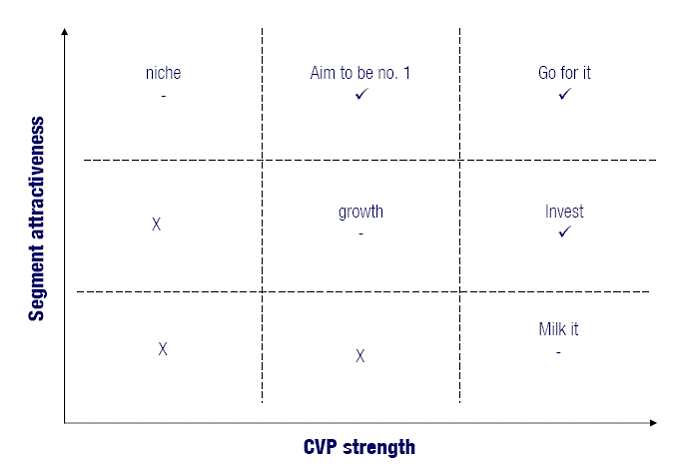
This will give you some real clarity in terms of how to prioritise your resources and what your strategy needs to focus on and do well. If your propositions land on the ‘X’, unfortunately in this case, ‘X’ does not mark the spot – it marks stuff for you to stop doing…
Step 5 – Gaps
Now you can look for gaps. If you’ve got some cracking great holes on the right of your matrix, time to get improving all of your propositions…
Step 6 – Implications
Work out what you’re going to do about the gaps. Invent new things? Re prioritise your audience? Develop existing things?
Step 7 – Develop Strategic Details
Now you know everything – you can work out what you’re going to do and why. Fill in the other ‘w’s – who, by when, where (and how- ok I know that’s not a ‘w’)…this will give you an action plan (which in essence is what the strategy is)
Step 8 – Functional Policies
Knowing what you want to do may need some changes in staff practices, policies etc – now’s the time to work these things out
Step 9 – DO IT
Stop picking fluff out of your belly button and go and deliver your strategy, damn you.
There you go – the nine and a half step strategic process as I’ve been experiencing in the last couple of weeks…I’m up to about step four and a half…
Who knows what I’ll write about in 2 weeks time…?! Any ideas?
Do you have any other thoughts about the strategic process?
 Sam Grayston
Leave a comment