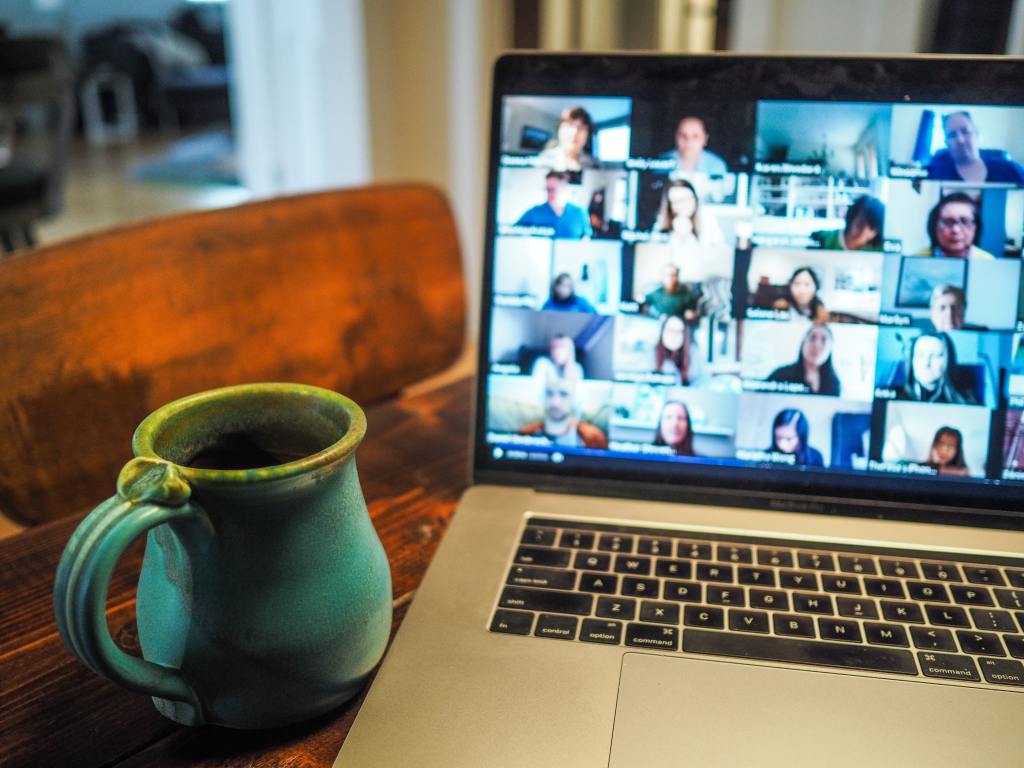
Do you know how big your ‘self-view’ video is on Zoom when someone else is sharing content? It’s pretty small, right? In fact, on my 27” monitor, when Zoom is fullscreen and someone is sharing content, every person’s video is about 1.5” x 1” (4cm x 2.5cm).
Do you know how big the content is? On my monitor, it’s 16” x 10”. That means that you could fit about 100 people’s videos into the size of the content. Are we really saying that when someone is presenting, everyone else’s input is only worth about 1/100th of the value? No wonder people don’t bother contributing or turning their video on; the app is telling them they are not as valuable or worthy as whatever is being shared.
This was thrown into sharp focus for me recently when I prepared for, and then delivered, an in-person workshop. The team and I spent lots of time crafting and refining slides in preparation for the event to drive the agenda and content. But when we started working together in person at the event, the slides faded into insignificance compared to the actual conversations that took place, and the space I was sharing with other human beings. Suddenly, the slide content was a mere backdrop, not a foreground, and the interactions and individuals took centre-stage. The engagement from participants was absolute, the interactions were insightful and fun, and the outcomes were undoubtedly better.
When we are in person, the people are the most important thing.
My personal and professional purpose is to liberate the greatness in others. I believe that humans are inherently brilliant, and if we can only find ways to help each other to switch off their censors and unleash their genius, we’ll all fly. And here was an event where, what I’d prepped, may have been in the way of liberating greatness. This event was a humbling reminder of what I instinctively knew anyway; that when we are in person, the people are the most important thing.
There’s a building consensus that online, or e-learning, wasn’t successful for children during the pandemic. Whilst schools are all back in classrooms now, we haven’t yet applied some of this understanding to the corporate world. I’m certainly not advocating for getting everyone back into offices – in fact, I think most of the time, most of the work we do can be done from anywhere. When we are expecting to learn, collaborate, and workshop ideas through however, then prioritising the human attendees’ experience must be the best way.
I make a distinction between just being ‘in-person’ and prioritising attendees, because I think we can do so much more through our current media of choice (Zoom or MS Teams or a.n.other) to recognise that we’re sharing the time and space together as ingenuous, brave, collaborative, thought-provoking human beings.
I’ve been on two, online, two-day short courses recently. One course used only three slides, temporarily, over the entire duration of the course and it changed my life for the better. One had nearly 400 slides onscreen the whole time over two days and made me wish I’d made better life choices.
I don’t believe this is all our fault. My hypothesis is that attendees on calls are acting in alignment with what the apps are telling them – that they not as valuable as the ‘content’ being shared. And, with this self-fulfilling prophecy, engagement declines, thinking stops, cameras go off, mics go on mute, and we’re reduced to a quiet box in the corner, overshadowed by what, visually, we’re being told is important – i.e., not us.
We must reclaim the human face of meetings, especially when we’re online. We must endeavour to think about the experiences of the attendees, show them their contribution matters, and value their input and creativity as human beings. I, for one, will hack-and-slash the number of slides I ever choose to use again on screen and stop sharing them as soon as I can, if it’s required at all. I encourage you to do the same. If we don’t, we risk losing the insights and inputs from the attendees that can sustain and save our organisations from irrelevance.

 Sam Grayston