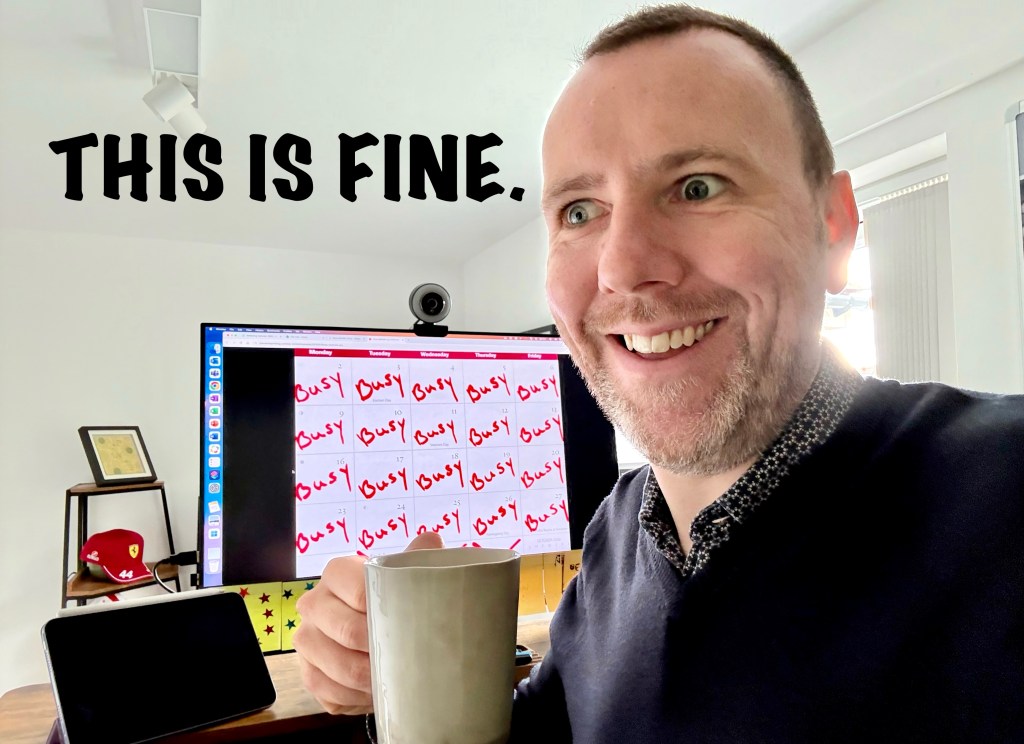
“I’m always firefighting. There’s no time to think.”
I can’t remember the first time I heard this phrase, but I hear it A LOT – particularly when I’m coaching senior leaders in transformative and project leadership roles.
And whilst evocative of modern time-management (or lack thereof) has to be a better way, right? Well this got me thinking, and a confluence of three things sparked this blog:
- Someone using this phrase in a coaching session…again!
- Reading about systems thinking.
- Watching the Apple TV+ show, Smoke.
A bit of context about each, and then the thought…
The phrase
It paints a clear picture…or we can all think of the meme with the cartoon dog in the house that’s on fire saying ‘this is fine’…everything’s going a million miles per hour and we have to move from one crisis to the next, urgent to urgent to urgent – never doing the important things we promised ourselves we’d do, like strategic thinking, self-development, 1:1s with others, improving processes, etc.

Systems Thinking
This is something that I’ve dabbled with on and off for years. In the first instance, I didn’t really get it. Someone sent me a video of blobs moving around rectangles and said ‘I think you’re going to love it’…
More recently, I’ve come to understand more about systems and how interconnected everything is – that is, whatever happens may be as of a result of something else far away in the system, or whatever we do may have far reaching and unintended consequences on the wider system. And that, traditionally, when things go wrong people tend to analyse; that is, break the problem down into smaller and smaller constituent parts – e.g. an app fails and analysis tells us a line of code needs rewriting, whereas Systems thinking asks us to synthesise, or to look up at the wider systemic nudges that may cause the problem – e.g. an app fails because of management pressure to ship fast on smaller budgets.
Smoke
This is a show on Apple tv+ about a fire scene investigator partnering up with a cop to identify and catch two serial arsonists. No spoilers, but it’s far more compelling than I thought it might be to start with. The fire scene investigator character, played by Taron Egerton, often delivers talks to trainees about the chaos of fire and being prepared.

The confluence
This got me thinking, if a fire kept happening in the same place, you wouldn’t want to keep relying on the fire brigade/department to come and put it out…you’d solve the reason why the same thing kept happening…so why don’t we do this at work when people describe their entire jobs as ‘fire fighting’?
I can’t imagine a fire fighter loving having to revisit a scene time and time again if a fire keeps getting ignited there – they’d want to put some other measures in place – systemic changes – sprinklers, better equipment, arrest the arsonists, create escape plans.
This approach could apply to the highly flammable systems in the workplace because it’s not ok to perpetually expect colleagues to be fire-fighters – presumably we want them spending their time adding value and putting their hard-won skills and experiences to work rather than rushing around, meeting to meeting, putting out things that have gone wrong.
Setup Sprinklers
In the immediate term, a knowledge-work equivalent of the sprinkler system might need setting up. If a fire keeps breaking out, having something to immediately dampen it down might be a reasonable temporary solution. In our imagined knowledge-work based equivalent, maybe that’s a standing meeting, decision forum, Andon Cord, or emergency WhatsApp channel that can be triggered straight away to solve the biggest crises and challenges.
Improve Equipment and Systems
The system is broken if fires keep breaking out. The system needs fixing. In the same way that if a restaurant kept catching fire they might need some better quality ovens, in our knowledge-work environment, we need higher quality systems that avoid these fires breaking out. Maybe it’s visualising all the work that’s going on so that people can see a potential fire brewing. Maybe it’s limiting work in progress so that more work can’t be shoved into an already overloaded system. Maybe it’s building in slack, recovery, creativity time into work.
To continue the fire metaphor, sometimes a fire-break is required in order to break the spread of the chaos and put new systems in place and so it may be with our work systems. It’s not ok that colleagues describe their working days as perpetually being on fire, we have to find better systems.
Arrest the Arsonists
If you’re the fire fighter in this scenario, then I’m going to assume it’s not you lighting the fires…you keep putting them out. So who IS lighting them? Stop them. Take their jerry cans of fuel away.
If it’s people adding stuff to your plate, check out the No Repertoire from Greg McKeown; if it’s people bringing you down, stop spending time with them; if people change their mind every five minutes, perhaps introduce something like the RAPID decision-making framework and force people to take some responsibility.
Develop Escape Plans
And, if it can’t be prevented, fire breaks out – then you need an escape plan. Getting away from your desk for a minute to assess the situation, having a friend to call, taking a holiday, going for a walk all may be release valves for dealing with these situations.
There’s a reason firefighters have to have breaks and spend a lot of time training – it’s not tenable to be doing it all the time. And it isn’t for us either. We need breaks, we need training, we need recovery if we’re going to have to fight fires at work.
These are some ideas I’ve been kicking around on firefighting. What other techniques could people try to change the system and stop the arsonists?

 Sam Grayston