Tag: communications

  • We’ll need to get better at thinking.

    We’ll need to get better at thinking.

    As soon as ChatGPT started to take off, I started saying,

    We’ll have to get better at thinking. We’ll have to start thinking more deeply and think harder if we want to stand out and succeed.

    Turns out, it’s even more dramatic than that!

    Excessive use of ChatGPT is rotting your brain! Fact.

    A fascinating study, just released from MIT, shows that excessive use of ChatGPT is actually reducing the quality of cognitive function.

    Research shows that LLM users consistently underperformed at neural, linguistic and behavioural levels when performing writing tasks.

    • Neural: EEG brain studies found that there was a 47% reduction in brain activity with heavy ChatGPT users. Their brains were using 47% less neural connections when they were writing with the model.
    • Behavioural: 83% of heavy model users couldn’t quote anything from what they had just written, compared to about 10% from using no technology to write.
    • Linguistics: neutral analysis found that writing with LLMs was ‘soulless, empty, lacking individuality, typical’.

    Listen to this great podcast with Cal Newport and one of the writers of the study, Brad Stulberg, to get the full picture.

    They use writing as a proxy for thinking as it is a cognitively hard task requiring lots of neural, linguistic and behavioural levels. It is, in essence, one of the ways we make sense of our thoughts. To put them to paper. And we are increasingly outsourcing our thinking to LLMs.

    They use the metaphor of physical fitness to make sense of the use of LLMs in writing: using LLMs being the equivalent of taking a forklift truck to the gym – sure, you go to the gym, but you don’t get the physical benefits. Or munching on junk food as the equivalent of consuming TikTok videos. It’s a good metaphor that they continue by coining the term ‘cognitive debt’ and even start to consider the possibility of a cognitive obesity crisis equivalent in the future.

    It’s incredible to think that brain function decreases by using and relying on LLMs. We’re not absorbing what it puts out and building new understanding, we’re actually losing our ability to think and reason!

    It’s a massive warning to those companies pursuing LLMs in everything – particularly for their own workers. In essence, you’re reducing the quality of thinking in your workforce if you promote high use of LLMs in solving the company’s challenges.

    This is where something like Time to Think comes into it’s own. It becomes the kind of ‘cognitive gym’ that Newport and Stulberg talk about in the podcast. It’s a protected way of being that encourages the very highest quality, independent thought. It’s going to become essential.

    I said it before, and I’ll say it again – we’re going to need to get better at thinking. We’re going to need to practice it more. We’re going to have to go deeper and harder with our thinking to flourish and thrive as a species.

    I’m not afraid of that. In fact, I welcome it. If you want to think with me, get in touch.

  • Why we must reclaim the human face of meetings

    Why we must reclaim the human face of meetings

    Do you know how big your ‘self-view’ video is on Zoom when someone else is sharing content? It’s pretty small, right? In fact, on my 27” monitor, when Zoom is fullscreen and someone is sharing content, every person’s video is about 1.5” x 1” (4cm x 2.5cm).

    Do you know how big the content is? On my monitor, it’s 16” x 10”. That means that you could fit about 100 people’s videos into the size of the content. Are we really saying that when someone is presenting, everyone else’s input is only worth about 1/100th of the value? No wonder people don’t bother contributing or turning their video on; the app is telling them they are not as valuable or worthy as whatever is being shared.

    This was thrown into sharp focus for me recently when I prepared for, and then delivered, an in-person workshop. The team and I spent lots of time crafting and refining slides in preparation for the event to drive the agenda and content. But when we started working together in person at the event, the slides faded into insignificance compared to the actual conversations that took place, and the space I was sharing with other human beings. Suddenly, the slide content was a mere backdrop, not a foreground, and the interactions and individuals took centre-stage. The engagement from participants was absolute, the interactions were insightful and fun, and the outcomes were undoubtedly better.

    When we are in person, the people are the most important thing.

    My personal and professional purpose is to liberate the greatness in others. I believe that humans are inherently brilliant, and if we can only find ways to help each other to switch off their censors and unleash their genius, we’ll all fly. And here was an event where, what I’d prepped, may have been in the way of liberating greatness. This event was a humbling reminder of what I instinctively knew anyway; that when we are in person, the people are the most important thing.

    There’s a building consensus that online, or e-learning, wasn’t successful for children during the pandemic. Whilst schools are all back in classrooms now, we haven’t yet applied some of this understanding to the corporate world. I’m certainly not advocating for getting everyone back into offices – in fact, I think most of the time, most of the work we do can be done from anywhere. When we are expecting to learn, collaborate, and workshop ideas through however, then prioritising the human attendees’ experience must be the best way.

    I make a distinction between just being ‘in-person’ and prioritising attendees, because I think we can do so much more through our current media of choice (Zoom or MS Teams or a.n.other) to recognise that we’re sharing the time and space together as ingenuous, brave, collaborative, thought-provoking human beings.

    I’ve been on two, online, two-day short courses recently. One course used only three slides, temporarily, over the entire duration of the course and it changed my life for the better. One had nearly 400 slides onscreen the whole time over two days and made me wish I’d made better life choices.

    I don’t believe this is all our fault. My hypothesis is that attendees on calls are acting in alignment with what the apps are telling them – that they not as valuable as the ‘content’ being shared. And, with this self-fulfilling prophecy, engagement declines, thinking stops, cameras go off, mics go on mute, and we’re reduced to a quiet box in the corner, overshadowed by what, visually, we’re being told is important – i.e., not us.

    We must reclaim the human face of meetingsespecially when we’re online. We must endeavour to think about the experiences of the attendees, show them their contribution matters, and value their input and creativity as human beings. I, for one, will hack-and-slash the number of slides I ever choose to use again on screen and stop sharing them as soon as I can, if it’s required at all. I encourage you to do the same. If we don’t, we risk losing the insights and inputs from the attendees that can sustain and save our organisations from irrelevance.

  • How to Rock a Pitch

    How to Rock a Pitch

    I recall the first time I noticed how much people love over-acting. I’ve always loved theatre. I’ve been fortunate enough to act, direct, design, light, write and watch many theatrical performance. I remember this one time I was watching a theatre production of a Shakespeare play and one of the characters comes in to find his pal is dead. He wails and shouts and screams and ends up dead herself. I remember feeling a bit awkward about his performance. It was a bit too hammy for me.

    ott acting

    (more…)

  • Stop Pretending, and Start Innovating

    Stop Pretending, and Start Innovating

    I saw a really interesting position listed on the vacancies list called Head of Innovation the other day. I love the idea of innovation and I have sometimes been called ‘innovative’ and it got me thinking, if that were me, what would innovation need to thrive? Innovation doesn’t just happen, I don’t suppose. It needs certain parameters to happen. But what might those parameters be? Too restrictive and innovation is stifled. Too broad and nothing ever gets done. So what are the components of innovation? Well, here are my ideas:


    (more…)

  • A Presentation Blast from the Past

  • Do you dare choose your audience?

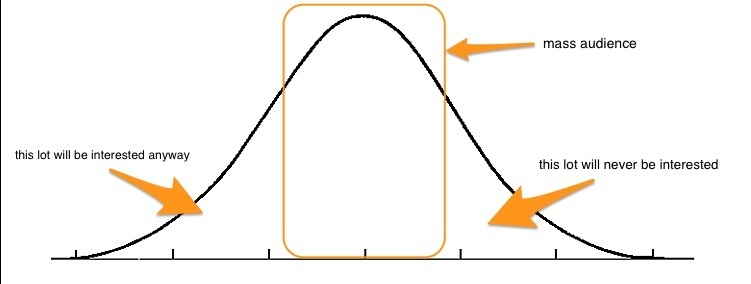
    I heard a very interesting point yesterday about marketing and the distribution curve thing, which got me thinking about daring to choose a target audience.

    The point being that in traditional terms, marketers try to target the ‘mass audience’ – i.e. that there is a large group of people who would want or need what you’re trying to sell and you make it as attractive as possible to that large group of people. On the left hand side of the mass audience would be the ‘early adopters’ who would buy what you’re selling anyway, and on the right hand side would be the ‘never evers’ who will never be interested in what you’re selling. The middle ground was the hallowed ground.

    Normal distribution curve
    Normal distribution curve

    Not any more.

    (more…)

  • A presentation is a creative entity in its own right

    OK, OK, so I haven’t kept to my promise to blog every couple of weeks throughout the strategy process. Sorry. I found that the actual doing got in the way of reflecting through this blog.

    Anyway, having completed a lot of the strategy work, I needed to present it to lots of different people, so today’s blog is about presentations.

    The most important mindset for presentation, I believe, is to think of your presentation as a creative entity in its own right. 

    A presentation is a creative entity in its own right

    It’s so important, I’ve said it twice.

    (more…)

  • A year to change the world

    I return to blogging inspired and enthused…I’m going to try to blog every two weeks about my new position:

    Writing a communications and engagement strategy for The Co-operative Membership by December 2013.

    Clearly, I’m not going to talk about the details on here, but processes, ideas, thoughts, how it’s going and the like and share my revelations (or not!). The first being to think about why on earth an engagement strategy would even exist…

    In most other businesses, the idea of engagement is relatively simple – it drives trade. For our co-operative, engagement has to do more than that. Co-operative members engaging with a core set of values and principles does far more than just drive trade – it can lead to loyal ambassadors and advocates of a fantastic idea of members coming together to meet social, economic and cultural needs and aspirations. Awesome starting point then. In fact, it could be too huge! There are so many things that member engagement could encompass – I’ll need to focus on the core principles of what it means to be co-operative and the benefits that may bring to the business.

    Wish me luck!