Tag: engagement

  • Stop Pretending, and Start Innovating

    Stop Pretending, and Start Innovating

    I saw a really interesting position listed on the vacancies list called Head of Innovation the other day. I love the idea of innovation and I have sometimes been called ‘innovative’ and it got me thinking, if that were me, what would innovation need to thrive? Innovation doesn’t just happen, I don’t suppose. It needs certain parameters to happen. But what might those parameters be? Too restrictive and innovation is stifled. Too broad and nothing ever gets done. So what are the components of innovation? Well, here are my ideas:


    (more…)

  • A Presentation Blast from the Past

  • Here’s a great aspiration for your team

    You know you’ve got a good team when…

    I’m sure there are hundreds of responses to this prompt. One that really sticks in my mind was from one team session I was working on. We were discussing our hopes and aspirations for the team and I was asking them what would you see and what would you hear (by the way, this phrase is brilliant for exploring notional ideas like respect, trust, teamwork).

    The response that stuck with me is

    “we will hear stupid questions”

    What a fantastic aspiration! A team that gets on well enough and is open enough not to worry about what other people will think if they ask a stupid question; where the stupid question is welcome.

    Ask a stupid question
    Ask a stupid question

    Hurrah for stupid questions. In fact, is the stupidest question the one you don’t ask?!

    How do you know when you’ve got a good team?

  • Do you dare choose your audience?

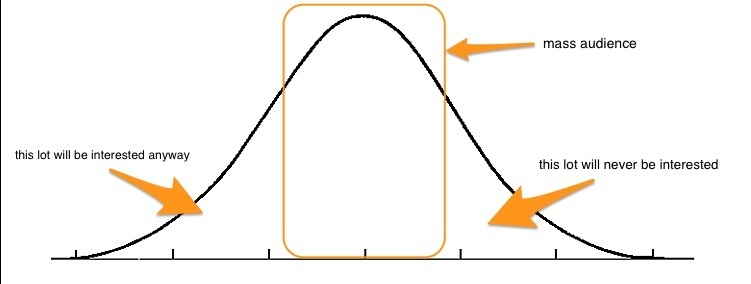
    I heard a very interesting point yesterday about marketing and the distribution curve thing, which got me thinking about daring to choose a target audience.

    The point being that in traditional terms, marketers try to target the ‘mass audience’ – i.e. that there is a large group of people who would want or need what you’re trying to sell and you make it as attractive as possible to that large group of people. On the left hand side of the mass audience would be the ‘early adopters’ who would buy what you’re selling anyway, and on the right hand side would be the ‘never evers’ who will never be interested in what you’re selling. The middle ground was the hallowed ground.

    Normal distribution curve
    Normal distribution curve

    Not any more.

    (more…)

  • A presentation is a creative entity in its own right

    OK, OK, so I haven’t kept to my promise to blog every couple of weeks throughout the strategy process. Sorry. I found that the actual doing got in the way of reflecting through this blog.

    Anyway, having completed a lot of the strategy work, I needed to present it to lots of different people, so today’s blog is about presentations.

    The most important mindset for presentation, I believe, is to think of your presentation as a creative entity in its own right. 

    A presentation is a creative entity in its own right

    It’s so important, I’ve said it twice.

    (more…)

  • Two ideas for stakeholder feedback

    Before asking your stakeholders for feedback, work out what you need feedback on

    It’s been just over 2 weeks since my previous blog on the 9 and a half step strategic process which I’ve been following and part of the reason this blog is a little late is because of all of the stakeholder engagement and feedback I’ve been involved with and am preparing.

    This is also my first mobile blog-from my iPad, sat in a Manchester apartment between today and the next!

    Today’s blog is about stakeholder engagement and getting feedback. Working for a co-operative means that I’m not in short supply of stakeholders…many of which want a say in how the strategy I’m developing will come into being. I think I’ve learnt two really important things for stakeholder feedback:

    (more…)

  • A nine (and a half) step strategic process

    Last time out was my seven starter points for strategic thinking and today I’m going to talk through the nine (and a half) step strategic process I’ve been following in my new role.

    Step 1 – Know yourself

    Sounds obvious, right? But this is where you’ve got to start. This isn’t about just knowing ‘I’m Sam and I’m an [fill in the blank]’. Knowing yourself is fundamental stuff – WHY do you do what you’re setting out to do with this strategy. Not just the stuff at the end of it (like selling stuff, engaging people, turning a profit) but what’s a the core. You might like to go back to the starter points to determine what you’re about.

    When you know what you stand for, you’ll be able to determine your vision and mission. Vision and mission differ – to have both, I think, is relatively important. Your vision is virtually unobtainable – it’s the utopia you are striving for. Your mission is focused on the length of the strategy (i.e. what do you see will happen in 3-5 years from now?).

    Your vision and mission will lead to loads of questions about ‘how will we know’? This is also where you need to establish some goals and targets.

    (more…)

  • Seven starter points for strategic thinking

    FROM HERE TO THERE A STRATEGY IS A JOURNEY

    My first blog about my new position is about seven starter points I’ve had to consider before I even get going on the content of the strategy. Things I thought I’d share as I guess they apply to every strategy process.

    My first frame of reference for the strategy was to think about a journey. After all, a strategy sets out how you get from your starting point to somewhere else.

    To help us determine the direction of travel, I needed to consider seven key things that you might want to think about for your strategy. As with any journey, there a number of considerations before you travel:

    1. What’s the destination? Where are we going?
    2. What mode of transport should we use?
    3. How do we keep the travellers safe and happy?
    4. How do we keep the drivers happy?
    5. How do we have the best journey possible? It is the fastest, most economical, most scenic or shortest?
    6. Programming the SatNav or reading the map
    7. Observing the Highway Code

    Only when you know these things can we actually plan the route and get on our way.

    (more…)

  • A year to change the world

    I return to blogging inspired and enthused…I’m going to try to blog every two weeks about my new position:

    Writing a communications and engagement strategy for The Co-operative Membership by December 2013.

    Clearly, I’m not going to talk about the details on here, but processes, ideas, thoughts, how it’s going and the like and share my revelations (or not!). The first being to think about why on earth an engagement strategy would even exist…

    In most other businesses, the idea of engagement is relatively simple – it drives trade. For our co-operative, engagement has to do more than that. Co-operative members engaging with a core set of values and principles does far more than just drive trade – it can lead to loyal ambassadors and advocates of a fantastic idea of members coming together to meet social, economic and cultural needs and aspirations. Awesome starting point then. In fact, it could be too huge! There are so many things that member engagement could encompass – I’ll need to focus on the core principles of what it means to be co-operative and the benefits that may bring to the business.

    Wish me luck!