Tag: ideas

  • Is there a Place for Seasonality at Work?

    Is there a Place for Seasonality at Work?

    One of my favourite places to walk is Westonbirt Arboretum near our home. It’s a great way to get back to nature and clear my head whilst supporting conservation work. On my most recent visit, I was marvelling at the structures of the trees now that all the leaves have fallen. These marvellous, decades-old organisms are saving all their energy and growth for spring: fresh buds, flowers, leaves, fruit. And it got me wondering if nature can teach us something about this time of year away from the pressures of ‘new year’s resolutions’ and towards embracing seasonality in our working lives?

    From the first of January, the start of the new calendar year, we’re often encouraged to set new goals and resolutions, and yet it’s a very arbitrary date. If we look to the rest of the natural world, it’s not starting afresh – it is midwinter! Plants are saving energy for fresh buds; animals are hibernating and hunkering down to be ready for spring; and here we are ‘getting after it’, ‘living our best life’, making radical changes…then not sticking with it, getting ill, and burning out. It doesn’t make much sense, it doesn’t appear to be very sustainable, and yet LinkedIn is full of people ‘bringing it on’ and ‘owning 2023’.

    We are connected to nature too – being human beings.

    Yes, reflect on the lessons of the previous season, nourish yourself with wholesome food, more knowledge, and enjoy movement; clear out unnecessary clutter and excesses of the past, but also be gentle, warm, kind and compassionate to yourself too. And when the first buds of new ideas and new goals arise, they will do so with greater clarity and fresh energy too.

    This is an invitation to not feel as great a pressure to set all those big goals and get started on everything now. Listen to yourself and to the natural world and respond appropriately. Reflect on what’s worked, what hasn’t; think about what you want to try out; maybe even explore a couple of ideas and experiments but consider that there may be a genuinely more invigorating time for renewal later.

    I am not saying do not do anything now.

    I know that life continues, that business thrives, that organisations endure. I’m merely advocating for observing more seasonality in our work and life – to acknowledge that there is ebb and flow, rather than being constantly ‘on’. For when we are ‘on’ 24/7, we run down to nothing and have nothing wonderful left to give the world. And I know that each and every person does have something extraordinary to offer.

    Personally, I’ve set goals for the next quarter and have a vision for the longer-term, but I’m not worrying about new year’s resolutions.

    And when you are ready to make the connections between those big, far-away goals and the experimental actions you want to start with today, then check out my Outcomes Tree idea. It’s an agile, responsive, and natural way to live in alignment with your purpose, bring value to your work, and change outcomes for the better.


  • The most stunning leadership statement I heard this year 

    The most stunning leadership statement I heard this year 

    Leadership is hard. In any organisation, at any level, being a leader requires clarity, calm and consideration. It requires people to paint such a compelling picture of a possible future that it seems like it could be a reality today. So much of the role of leaders is based on how they speak – and whether those words match their actions.

    I was wowed when I heard this statement from a leader’s opening remarks earlier this year. Rodrigo leads part of a large multi-national financial services provider. His words and actions impact work that serves millions of customers. He leads quarterly planning events that have thousands of attendees, and during his opening address, he said something that will stay with me forever:

    Your children know my name and I’ll have never met them. Your team members’ children know your name. What do you want them to say about you?”

    This was such an ingeniously human way of describing the impact leaders have, not just in the workplace, but in our lives more broadly. He knew that, whilst he won’t ever meet many of his team members’ children, they have probably heard his name at home. And he wants his people to talk about him positively to their children. By extension, he was making an extraordinary invitation to consider the impact his leaders have on their respective team members.  

    We can all think of leaders and managers we have talked about with disdain at home – to loved ones, friends, family (and children pick up on everything!). Those people close to us will have formed views and opinions of that leader and, potentially, by extension, that organisation. And because these people love us and want what’s best for us, their views will be strong-held based on what they hear. So, this wonderful statement was to ask us to consider how we’d like to be talked about when we’re not there. Do we want to be the leader that people are stressed and upset about and worry about interacting with, keeping people awake on a Sunday night; or do we want to be the leader that enthuses people to speak well about our organisation at home, to look forward to working with them, to bringing their best selves to work with us?

    As my coaching supervisor says to me, ‘how we do anything is how we do everything’and here’s a perfect example of how this can play out: our lives are complex webs of social interactions where each part of the system has an impact on the other.

    What kind of impact do you want to have on others?

  • Stop Pretending, and Start Innovating

    Stop Pretending, and Start Innovating

    I saw a really interesting position listed on the vacancies list called Head of Innovation the other day. I love the idea of innovation and I have sometimes been called ‘innovative’ and it got me thinking, if that were me, what would innovation need to thrive? Innovation doesn’t just happen, I don’t suppose. It needs certain parameters to happen. But what might those parameters be? Too restrictive and innovation is stifled. Too broad and nothing ever gets done. So what are the components of innovation? Well, here are my ideas:


    (more…)

  • Eight Things I’d like to see in iOS 8

    Eight Things I’d like to see in iOS 8

    It’s Apple’s World Wide Developers Conference (WWDC) 2014 next week, so I thought I’d join the speculation bandwagon and propose eight things I’d like to see in iOS 8.

    1. Actionable email

    Trash or More?…that’s not enough. Why can’t we swipe across an email and bring a whole host of option icons like trash, flag, move, calendar, remind me later (a la Mailbox or Dispatch)? Email is boring enough as it is, and so often requires an action, so why not bring it to life a bit and make it work?


    (more…)

  • A Presentation Blast from the Past

  • What Can Yahoo! Teach Us About Presentee-ism?

    There has been a very positive shift in working culture over the past few years that has encouraged employees to work from home more often – living the flexible working mantra, and understanding that being in a physical office (or not) does not necessarily mean that you are at work (or not!). I take advantage of this enlightened approach and work from home often: the technology allows me to access everything exactly the same as in the physical office, and I am judged not on my attendance in the office, but what I achieve in my role. Great…I thought.


    I was a big fan of this approach. Recently, however, I’ve started to consider (or notice) if presenteeism (being at the office all the time) can in fact lead to better results. And the thing that made me consider this is Yahoo!

    (more…)

  • The Seven Deadly Sins of Email: the abuses of electronic mail

    Imagine the scenario: it’s the 1960s and you’re a busy office worker. You’ve just finished up for your two-week summer holiday at Great Yarmouth, and you’re looking forward to riding the snails at the Pleasure Beach. When you return to work, you find over 200 memos in your intray.

    It wouldn’t happen…

    Jump forward to today…you return from your ten-day holiday on some Greek island to 200+ emails (or you might have even spent Sunday night going through them).

    How has this become acceptable?! How has email gone from a pretty geniune form of electronic correspondence to a catch-all pile of every type of information possible? And is it acceptable any more? I call on you all to repent for the seven deadly sins of email and live a virtuous, marvellous new world of email correspondance and make the best use of the other brilliant tools at our disposal for the other tasks that email has become.

    Here are, what I have deemed, the seven deadly sins of email (and what you can do about them):

    (more…)

  • PIES at your meeting

    PIES. Yum. Who doesn’t like pie?

    Pie
    Pie

    But on this occasion, I’m not talking about a tasty pastry and meat/fruit filling, oh no. I’m talking about a method of co-operative learning developed by Dr Spencer Kagan and that I learned whilst I was teaching. I recently thought that this model might be really useful to apply to modern, grown up meetings too. It works like this:

    (more…)

  • Here’s a great aspiration for your team

    You know you’ve got a good team when…

    I’m sure there are hundreds of responses to this prompt. One that really sticks in my mind was from one team session I was working on. We were discussing our hopes and aspirations for the team and I was asking them what would you see and what would you hear (by the way, this phrase is brilliant for exploring notional ideas like respect, trust, teamwork).

    The response that stuck with me is

    “we will hear stupid questions”

    What a fantastic aspiration! A team that gets on well enough and is open enough not to worry about what other people will think if they ask a stupid question; where the stupid question is welcome.

    Ask a stupid question
    Ask a stupid question

    Hurrah for stupid questions. In fact, is the stupidest question the one you don’t ask?!

    How do you know when you’ve got a good team?

  • Do you dare choose your audience?

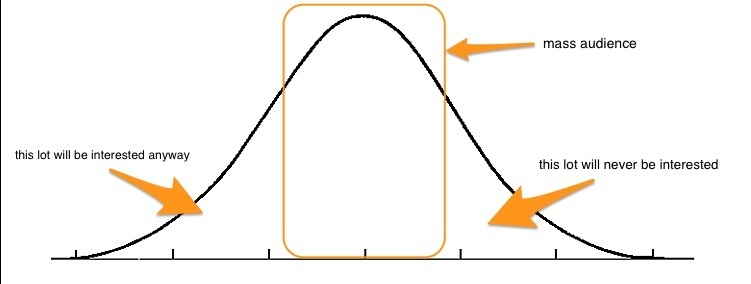
    I heard a very interesting point yesterday about marketing and the distribution curve thing, which got me thinking about daring to choose a target audience.

    The point being that in traditional terms, marketers try to target the ‘mass audience’ – i.e. that there is a large group of people who would want or need what you’re trying to sell and you make it as attractive as possible to that large group of people. On the left hand side of the mass audience would be the ‘early adopters’ who would buy what you’re selling anyway, and on the right hand side would be the ‘never evers’ who will never be interested in what you’re selling. The middle ground was the hallowed ground.

    Normal distribution curve
    Normal distribution curve

    Not any more.

    (more…)